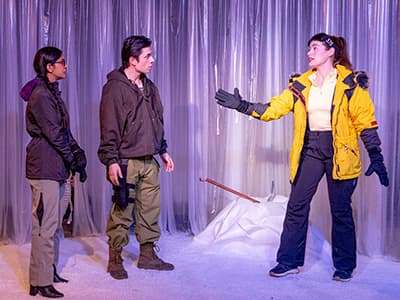
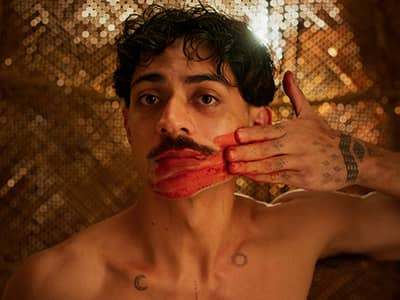
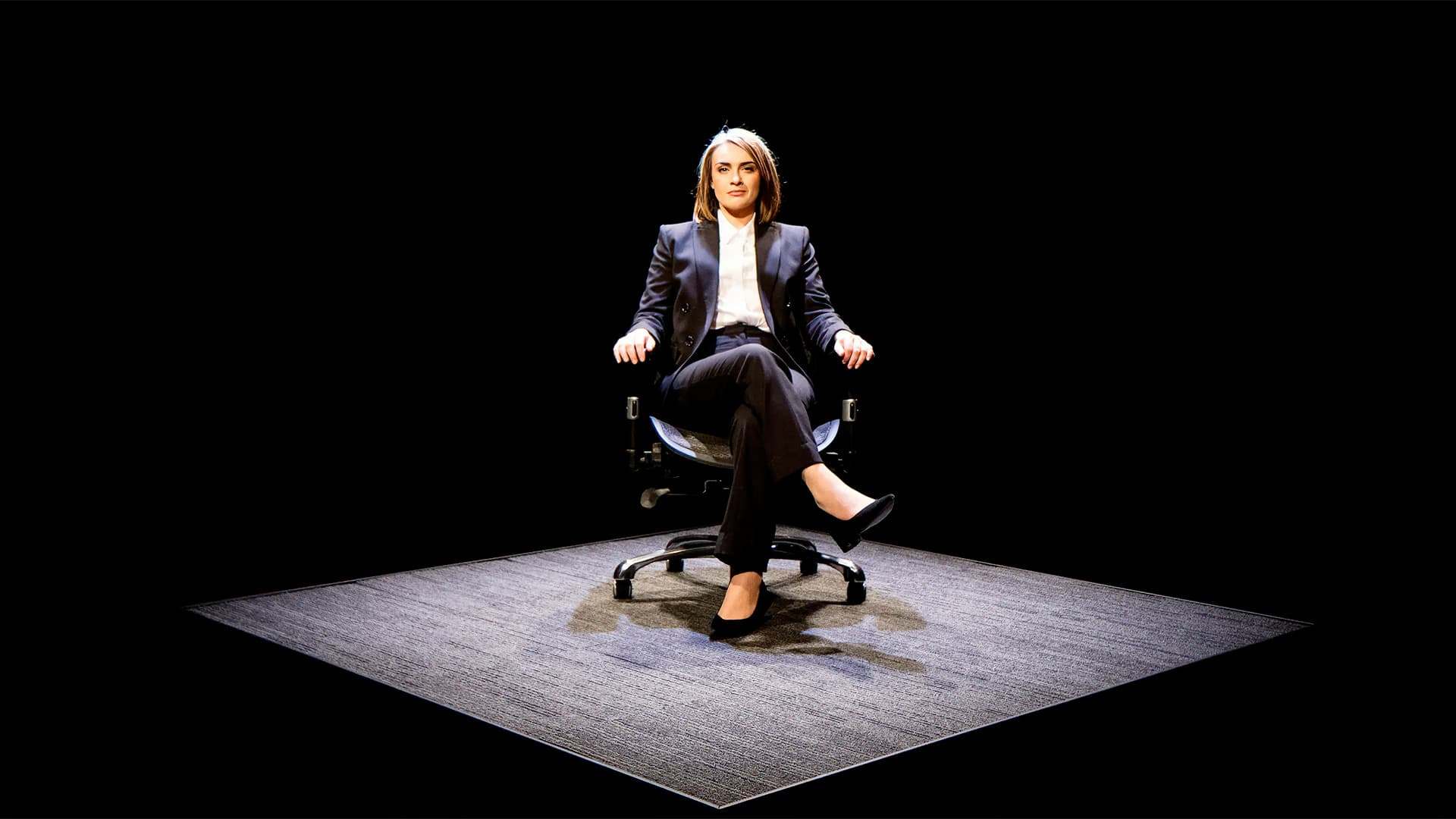
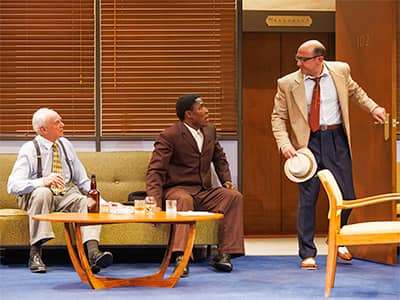
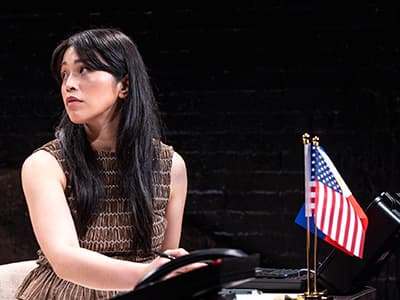
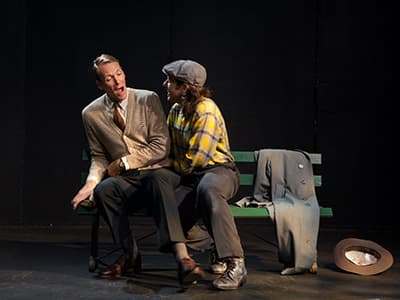
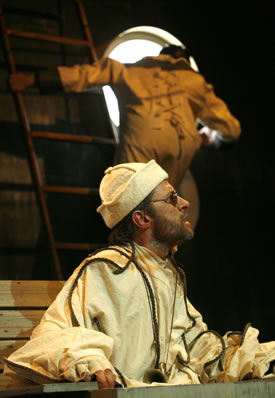
 Left - (l-r) Peter Houghton and David Tredinnick. Cover - (l-r) Richard Bligh and Evelyn Krape. Photos - Ponch Hawkes
To stage this 20th Century masterpiece, there couldn’t be a more perfect setting than the Eleventh Hour Theatre. First staged in 2006, this consistently impressive theatre company makes a welcome debut to the Melbourne International Arts Festival.
In Endgame by Samuel Beckett, outside life is non existent. It is neither life nor death, day nor night. Each day is ritualistic for the four characters, their purpose in life the same as the day before. And as we enter the small converted church, hidden away in Fitzroy, we are soon engulfed in the intriguing world of Beckett.
Beckett’s second play, Endgame focuses on a quartet of characters living a static life, amid their refusal to accept the ‘end.’ Originally written in French, the title emerged from the final point in a chess game where the losing player, despite only a few pieces left, refuses to accept defeat. In likeness to the themes in all of Beckett’s works, these characters are aware of the end yet cannot bring themselves to face it.
The main action of the play centres on the dialogue between the two protagonists. Hamm is an irascible aged master, confined to a wheelchair because he is blind and cannot stand up. In contrast, his servant Clov cannot sit down and is confined to resentfully serving his master. Mutually dependent, these two characters exist to fight and fight to exist, interrupted only by Hamm’s legless parents Nagg and Nell. Confined by the petulant tyrant who is their son, these two live out their days in rubbish bins, reminiscing the happier past. “Can there be misery loftier than mine?” booms Hamm, and the actions of the play are formed. Each character lives out their day in misery, each day an exact replica of the one prior.
Without a doubt, they are all incredible performances. The actors have a wonderful connection with one another and although confined in their character’s physicalities, their performances prove animated and are an amazement to watch. They handle the dry language of Beckett with immense ease and bring the humour of the script to life with their strong comedic ability.
Peter Houghton playing Hamm gives an undeniably outstanding performance. Completely unrecognisable from his one man play The Pitch, Houghton delivers every line with the understanding of what is Beckett. His carefully measured pauses illuminate the emptiness of his existence and his strong characterisation of a man painfully waiting for nothing touches a raw nerve in every spectator.
David Tredinnick as Clov is equally as spine-tingling. Trudging around the stage with his stilted legs and deformed toes, Treddinick captures the very essence of Clov – fear of change. Although placating Hamm with threats of deserting him, Clov is terrorised at the thought of being alone and thus, does nothing but assume his fate.
Despite holding the smallest role of the play, Evelyn Krape gives a performance to savour as Nell. She moves effortlessly between the emotions for her husband – from her girlishness love for him, right down to her stricken hollowness at every mention of his comedic anecdotes.
And nothing short of mesmerising is Richard Bligh as Nagg. Every movement, every gesture, every spoken word is a heartfelt response to the perils of his life – his vindictive son, the tragic accident and the happiness he and Nell once shared together.
All facets of this production are brilliantly in sync – incredibly well directed, inspired performances and complete comprehension of the script. As set designer, Julie Renton’s interpretation of the world of the play could not be more accurate. The traverse seating draws our focus to a gloomy brick tavern, filled with rubble and decay. Reachable only by ladder are two hideous portholes, opened at the request of Hamm from his delightfully humorous wheelchair. Nagg and Nell’s rubbish bins are cleverly placed opposite to Hamm, forcing the audience to be the middleman in each exchange of dialogue.
These characters are checkmated. They cannot move forward or back, whether from a physical or mental confinement. They rely on one another for their unhappiness and therefore survival. We chuckle as we watch their bleak lives play out however our laughter subdues as we become unsettled by this. Beckett plays a horrible joke on us, when stating that ‘nothing is funnier than unhappiness.’ As we leave this intimate space, we are left to ponder what humour exists in the lives most important to us – our own.
Melbourne International Arts Festival presents
Samuel Beckett: Endgame 1958 – 2008
The Eleventh Hour
Venue: The Eleventh Hour Theatre | 170 Leicester St, Fitzroy
When: Mon 20 – Thu 23 Oct at 8pm
Fri 24 & Sat 25 Oct at 7pm & 9.30pm
(Performance on Wed 22 Oct followed by post show Q&A)
Duration: 1hr 30min no interval
Prices: Full $45 / Conc $25
Bookings: Ticketmaster 1300 136 166 / www.melbournefestival.com.au
There is a reason The Sapphires has become one of Australia's most beloved musicals.
3 June 2026
Canberra
2 June 2026
Sydney
30 May 2026
Sydney
Latest Reviews
Endgame | The Eleventh Hour
- Details